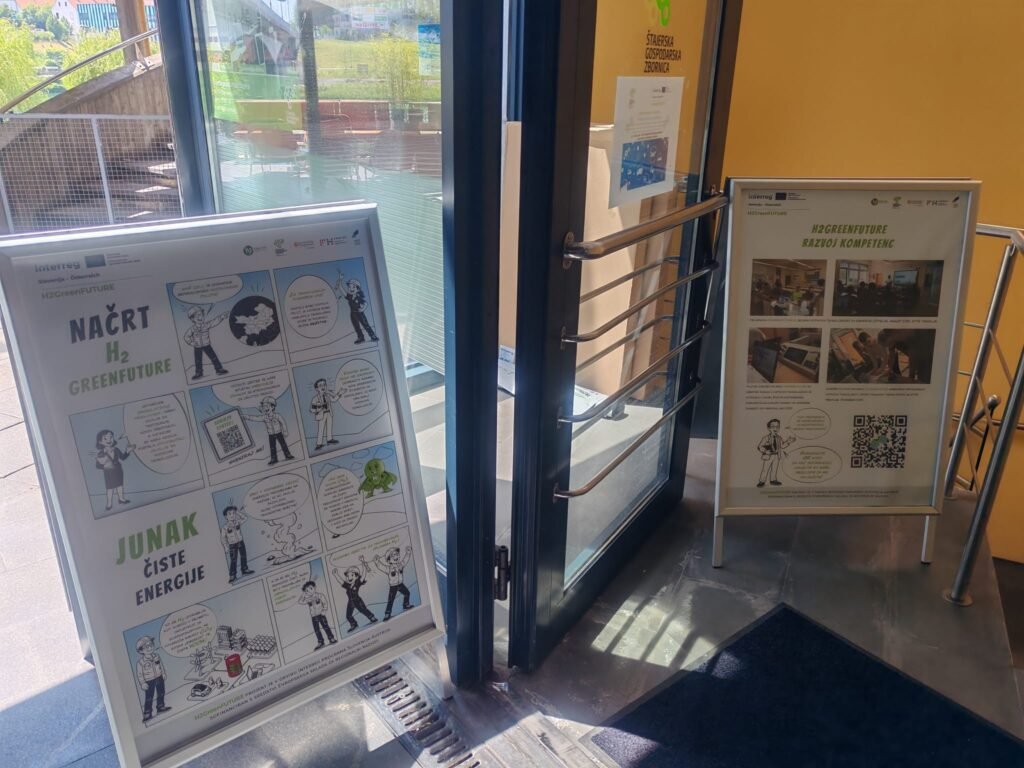
Green Sustainable Solutions participated in the H2GreenFUTURE 3rd Interregional Congress, held on 27 May 2026 at the Chamber of Commerce and Industry of Štajerska in Maribor. The event focused on “Hydrogen Technologies: Opportunities and the Legislative and Regulatory Framework in the Slovenia–Austria Region”, bringing together representatives of public institutions, industry, research organisations and regional stakeholders.
The congress addressed the role of hydrogen technologies in the green transition, with particular attention to the legislative, regulatory and development aspects of hydrogen deployment. The programme included presentations on the legal and regulatory environment, the development of hydrogen technologies in Slovenia, the action plan for achieving hydrogen-related NECP targets, the design of the Ljubljana hydrogen ecosystem, hydrogen buses, critical energy infrastructure, industrial use of hydrogen, education and training, and cross-border cooperation between Slovenia and Austria.
GSS was represented at the event by Dinko Đurđević, who followed the discussions on hydrogen ecosystem development, regulatory readiness and practical project implementation. The event provided a relevant overview of how Slovenia, in cooperation with Austria, is moving from studies and strategic analysis towards concrete hydrogen deployment.
A key message from the congress is that hydrogen implementation requires a coordinated ecosystem approach. Several Slovenian and Austrian initiatives presented during the event show that project development is increasingly shifting towards operationalisation, supported by strategic planning, institutional alignment and concrete project pipelines. Slovenia’s ambition, supported by its forthcoming hydrogen strategy and long-term implementation perspective towards 2040, represents an important step forward in regional hydrogen development.
The Slovenian-Austrian example confirms that the next phase of hydrogen development must focus on implementation capacity. This includes clear regulatory pathways, bankable project concepts, coordinated investment planning, technical readiness, stakeholder cooperation and alignment with national and regional strategies.